
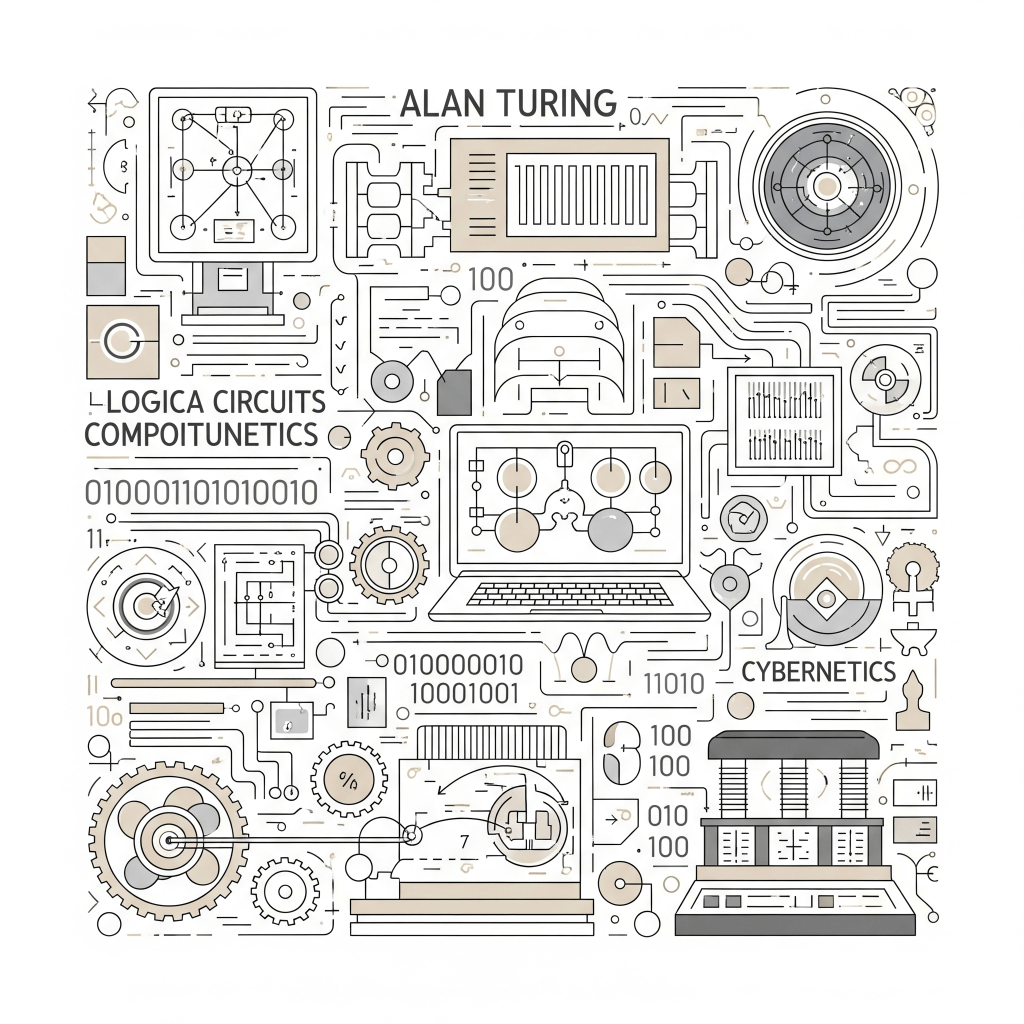
The philosophical and logical foundations needed a physical embodiment. The mid-20th century saw the emergence of the theoretical and practical computing capabilities essential for AI to take shape.
Alan Turing’s Vision: The Computable Mind and the Imitation Game
A pivotal figure in bridging abstract theory with the potential for machine intelligence was Alan Turing, a man I frequently reference in my daily work. In 1936, Turing created the theoretical “Turing machine,” a mathematical model of computation that laid the fundamental basis for modern AI and profoundly shaped the development of computer technology in subsequent decades.4 His seminal 1950 paper, “Computing Machinery and Intelligence,” directly addressed the question, “Can machines think?”.1 In this paper, he proposed “The Imitation Game,” now widely known as the Turing Test, as a means to assess machine intelligence.1 The test’s premise is straightforward: if a machine can engage in a conversation indistinguishable from that of a human, it could be considered intelligent.3
Turing’s work is pivotal because it translated abstract philosophical questions about “thinking machines” into a concrete, albeit theoretical, computational model (the Turing machine) and a measurable, if controversial, behavioral test (the Turing Test).4 This provided a tangible goal for AI researchers and a theoretical underpinning for the very possibility of machine intelligence.
However, the Turing Test has faced several criticisms. It has been argued that the test primarily measures a machine’s “humanness” rather than its general “intelligence,” as human and intelligent behavior are not always synonymous.3 Critics also point out that the test focuses solely on external behavior, potentially allowing a machine to simulate thinking without possessing actual understanding or consciousness.3 Furthermore, some mainstream AI researchers view trying to pass the Turing Test as impractical and a distraction from more productive research, preferring direct testing methods for specific tasks.3 The subsequent criticisms of the Turing Test further refined the understanding of “intelligence” within the AI community, pushing researchers beyond mere imitation towards more robust problem-solving capabilities.
Early Computing: Hardware and Software Pioneers
Following Turing’s theoretical groundwork, the mid-20th century witnessed significant advancements in computing hardware and software, providing the necessary infrastructure for AI. Large-scale mechanical computer systems began to be constructed in the 1940s.4 In 1945, mathematician John Von Neumann wrote “The First Draft of a Report on the EDVAC,” a paper that detailed the design principles of modern computers.4 Around the same period, the invention of the transistor played a crucial role in making computers smaller and more efficient.4
The 1950s saw further improvements in computing. Grace Hopper, a mathematician and computer scientist, developed the first compiler, a tool that translated English-like commands into mathematical code, and also contributed to the development of the COBOL programming language.4 By the end of the decade, the first computer operating system had been developed.4 The progression from Turing’s theoretical machine to the actual construction of large-scale computers and the invention of components like the transistor demonstrates a crucial causal relationship: AI could not move beyond philosophical speculation without the physical means to implement its ideas. The development of compilers and operating systems further enabled more complex programming, allowing AI researchers to build increasingly sophisticated algorithms. This highlights that AI’s progress is intrinsically tied to advancements in underlying computing technology, a trend that continues to this day with developments like GPUs and large language models.
The Influence of Cybernetics
Parallel to the nascent field of AI, cybernetics emerged in the 1940s, pioneered by Norbert Wiener.7 This interdisciplinary field focused on feedback mechanisms in biological and mechanical systems, emphasizing principles of information flow and regulation.7 Early applications of cybernetics were seen in the control of physical systems, such as aiming artillery or designing electrical circuits.8
While both AI and cybernetics aimed for machine intelligence, they often approached the problem from different conceptual stances. AI, particularly in its early symbolic forms, often operated on the presumption that knowledge is a “commodity” that can be stored inside a machine, and that applying this stored knowledge constitutes intelligence.8 Cybernetics, conversely, explored the constraints of any medium (technological, biological, social) and how knowledge is constructed through interaction and feedback loops.8
The emergence of cybernetics alongside early AI illustrates that the quest for machine intelligence was not a monolithic endeavor. Cybernetics, with its focus on self-regulating systems and feedback, provided an alternative conceptual framework to the symbolic manipulation paradigm that initially dominated AI. Early work on neural networks, then called perceptrons, stemmed from this cybernetic influence.8 However, the “fashion” of symbolic computing later rose to “squelch” perceptron research.8 This demonstrates how theoretical biases and perceived limitations, such as those later exposed by Minsky and Papert, could lead to the suppression of promising alternative approaches, only for them to resurface later when new insights or computational power made them viable. This cyclical nature of research focus is a recurring theme in AI’s history.


 Techné & Logos